Declarative automation

An agent should be a step, not the runtime.

Plug in any workflow or program. Scaffold runs it as nodes, with an agent only where judgment is needed.

Plug in any workflow or program.

Bring a workflow you built or a program from GitHub. Scaffold runs it on a schedule and watches every run.

How it works →
WorkflowInbox Triage6 steps
Programclean_contactsPython, imported from GitHub
Scaffold
  • Scheduled
  • Chained
  • Watched

Pay for judgment once, not every run.

Stored as repeatable tasks, workflows skip the model for everything that is not a decision.

Why it adds up →
Agent in the loop231,587
Scaffold1,263

99.45% fewer characters sent to the model on every run of a daily workflow.

Fold a whole workflow into one node.

Nodify a process once, then drop it into bigger workflows like any other step.

See a nested workflow →
Every morning WorkflowLead Follow-up5 steps inside Send summary

Five steps in. One node out.

See what every workflow is worth.

Success rate, failures and runs per workflow, so a business can see what its automation returns.

Explore analytics →
64runs recorded
55%success rate
29failed runs
Daily Report32
Lead Follow-up29
Inbox Triage2
Contact Cleanup1

Example workspace. Lead Follow-up fails until its agent is connected.

Every agent, in one overview.

Agents from ChatGPT and Claude live in Scaffold, next to the workflows they power.

More on agents →
AgentsChatGPTClaude
Claude
Draft follow-up emailsStep in Lead Follow-up
Running
ChatGPT
Summarize this week’s runsStandalone task
Completed
Claude
Review a program’s outputStandalone task
Queued

Example overview

The problem

Agents are wonderful once. Expensive as a habit.

The same reasoning, re-derived and re-billed on every run.

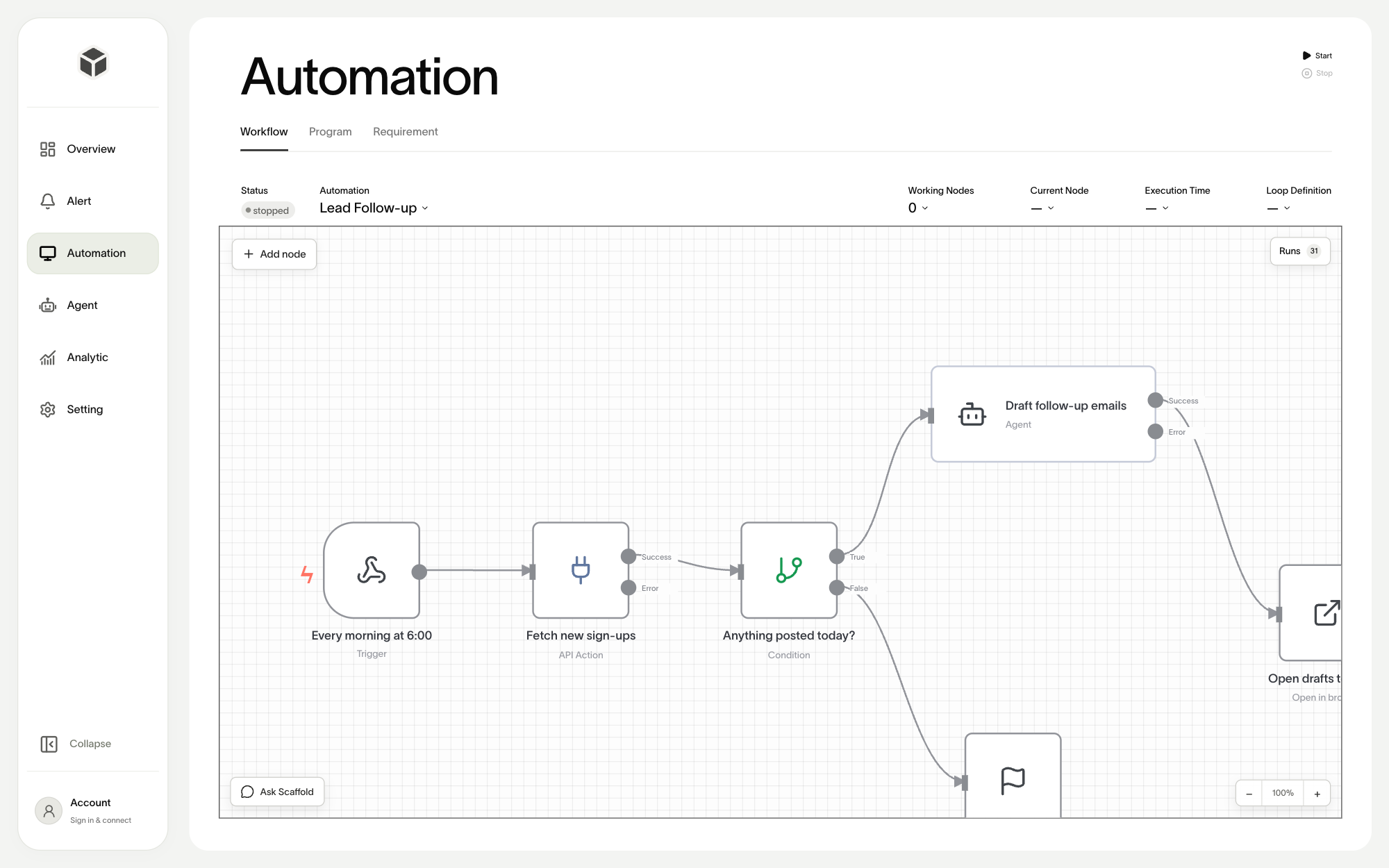
  1. TriggerEvery morning at 6:00A clock
  2. API actionFetch new sign-upsA request and a pattern
  3. ConditionAnything posted today?An emptiness check
  4. AgentDraft follow-up emailsJudgment
  5. Open in browserOpen drafts to reviewOpens links

Store the workflow, not the prompt.

Each step becomes a repeatable task. Only the step that needs judgment calls a model, so the token bill stops repeating.

See it run →
clean_contacts.py
def clean(contacts):
    for c in contacts:
        if c.email:
            keep(c.email.lower())
Program clean_contacts.py
in: JSONout: JSON result

Automate any workflow or program.

Plug in a workflow you built, or import a Python or JavaScript program from GitHub. It runs sandboxed, on a schedule, beside everything else.

See a program run →

See it run. Four example workflows.

Pick one and press run.

The Scaffold builder showing the Lead Follow-up workflow: a 6:00 trigger, a fetch of new sign-ups, a condition, an agent step that drafts follow-up emails, and a step that opens the drafts for review.

TriggerEvery morning
WorkflowLead Follow-up5 steps inside
ActionSend summary
Inside Lead Follow-up
  1. Trigger
  2. API action
  3. Condition
  4. Agent
  5. Open in browser

Nodify whole workflows.

Fold an entire workflow into a single node, then drop it into a bigger one. Automating a whole process becomes one step.

ChatGPTClaude
Agent Draft follow-up emails via Claude
4 other steps unchanged

Every agent, in one place.

Agents from ChatGPT and Claude live inside Scaffold beside the workflows they run in. One overview, on the subscription you already pay for.

Analytics

What every workflow is worth. Health, cost and benefit.

Time saved

9h 15mof work done by 35 completed runs

  • Daily Report32 runs × 15 min
  • Contact Cleanup1 run × 45 min
  • Inbox Triage2 runs × 15 min

Each square is 15 minutes nobody spent by hand. A failing workflow saves nothing.

Workflow health

55%success rate across 64 runs

Cost by step

  • Triggerno model
  • API actionno model
  • Conditionno model
  • Agentmodel call
  • Open in browserno model

Stopped is not failed

Stopped

Nothing new today. That is a success.

Failed

Agent not connected. That is a real problem.

Counting both as failures makes the number meaningless.

You have already tried this with an agent. It did not hold.

Agencies

The same intake for six clients, without their settings bleeding together.

Founders

Repeating workflows you would rather not babysit.

Builders

Programs you already wrote, finally running on a schedule.

Pricing

Stop paying a model to rediscover the same five steps.

Pick a plan by how many automations you run.

Individual

$0/month

Try Scaffold on the one workflow you repeat most.

1 automationFree for as long as you like

  • The visual builder, with all 9 kinds of node
  • Runs on a schedule, from a webhook, or by hand
  • Agents on your ChatGPT or Claude plan, no API keys
  • Every run recorded step by step
Start free

Starter

$20/month

For a handful of workflows you run every week.

Up to 5 automations$4 per automation

Everything in Individual, plus

  • Import Python and JavaScript programs from GitHub
  • Programs run sandboxed, offline unless you allow the network
  • Alerts the moment a run fails
Choose Starter

Pro

Best deal

$60/month

For a business automating in earnest.

Up to 20 automations$3 per automation, the lowest of any plan

Everything in Starter, plus

  • Analytics on every workflow: success rate, health and time saved
  • Nodify: fold a whole workflow into a single node
  • Every agent from ChatGPT and Claude in one overview
Choose Pro

Custom

$2,000to deploy

A specialist builds a custom automation for you.

+ $500/monthfor maintenance

What you get

  • A specialist maps the workflow with you
  • Built, tested and deployed for you in Scaffold
  • Monitored every month, and fixed when a site or API it depends on changes
Talk to a specialist